
| Art of the Print | ||||||||
| Home | Artist Index | Gallery | Catalogue | About Us | Our Policy | Contact Us | Site Map | Search |
|
|
|||||||||||||||||||||
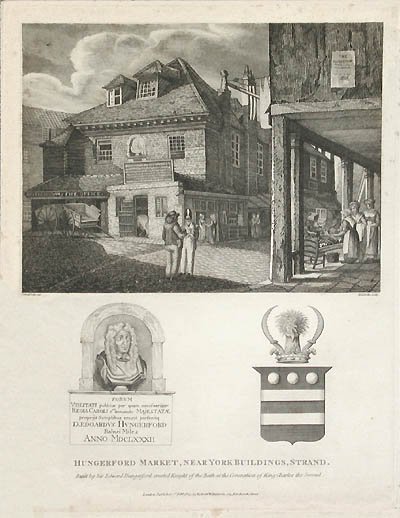
| Robert Wilkinson published "Hungerford Market, Near York Buildings, Strand" in 1825 for the Londina Illustrata. This original etching and engraving was engraved by William Maddocks based upon a design created by the British artist, Robert Bremmel Schnebbelie. This is a historically important and beautiful example of early English architectural art and the works of art published by Robert Wilkinson. The British Museum includes an impression of this original engraving in its permanent collection. |
| Title: | Hungerford Market, Near York Buildings, Strand |
| Publisher: | Robert Wilkinson, London |
| Engraver: | Maddocks, William (British, active early 19th century) |
| Designer: | Schnebbelie, Robert Bremmel (1780-1849) |
| Date: | 1825 |
| Medium: | Original Etching & Engraving |
| Source: | Londina Illustrata |
| Note: | Hungerford Market, Near York Buildings, Strand is a fine example of architectural engraving from this period. It was engraved by William Maddocks based upon a design created by the British artist, Robert Bremmel Schnebbelie. Schnebbelie contributed several drawings for many of the plates published by Robert Wilkinson for the Londina Illustrata, Graphic and Historical Memorials (1808-1825) in two volumes. The Londina Illustrata consisted of two hundred and six engravings including engraved titles as well as several double plates. These engravings depicted graphic and historical illustrations ,memorials of ancient appearances of the metropolis; and of the Religious Foundations, monasteries, Churches, Chapels, Meeting-houses, Schools, Charitable Foundations, Palaces, Halls, Court Processions, Places of early Amusements and Modern Present Theatres in the Cities and Suburbs of London and Westminster. Other William Maddocks contributions to this publication include, the South East View of the Grotto now the Goldsmiths's Arms of the Parish of St. Gerorge (1825), The Elevation of the Alms-Houes endowed by Sr Andrew Judd K(1825). |
| This original William Maddocks engraving and etching shows a view of Hungerford Market. The upper portion of this composition depicts both an accurate and scenic view of the famous London landmark where we can clearly see the activities surrounding both the market and the adjoining fire hall. The lower portion provides a close-up of the bust of Sir Edward Hungerford (seen at the front of the second story) and his coat-of-arms. The British Museum includes an impression of this original engraving in its collection. Registration Number, 1880,1113.2826 | |
| The first three decades of the nineteenth century marks a golden age for British architectural and topographical art. At this time a number of very skilled artists devoted their careers to accurate depictions of buildings and city streets. Within this oeuvre printmaking assumed a vital role and such great publishing houses as Ackermann, Robert Wilkinson and others prospered. | |
| Size: | 13 X 10 (Sizes in inches are approximate, height preceding width of plate-mark or image.) |
| Matted with 100% Archival Materials | |
| Buy Now | Price: $225.00 US |
| Condition: | Printed on early nineteenth century wove paper and with full margins as printed and published in London by Robert Wilkinson in 1825. Containing some foxing in the outer margins, else a fine impression and in good condition throughout. Hungerford Market, Near York Buildings, Strand represents a prime, original example of early British architectural art. |
| Subject: | Maddocks, Hungerford Market, Near York Buildings, Strand, William Maddocks, Robert Bremmel Schnebbelie, British artists, original etching and engraving, English architectural art, Robert Wilkinson, construction, Sir Edward Hungerford, London landmark, fire hall. |
| Important Information: | The artist biographies, research and or information pertaining to all the original works of art posted on our pages has been written and designed by Greg & Connie Peters exclusively for our site, (www.artoftheprint.com). Please visit us regularly to view the latest artworks offered for sale. We will soon be posting an update of our most recent research and include the biographical and historical information pertaining to our next collection of original works of art created by artists throughout the centuries. We hope you found the information you were looking for and that it has been beneficial. Our Gallery, (Art of the Print / www.artoftheprint.com) guarantees the authenticity of every work of art we sell 100%. Full documentation and certification is provided. We offer a wide selection of international fine art dating from the early Renaissance to the contemporary art period. |
Original Etching & Engraving by William Maddocks designed by Robert Bremmel Schnebbelie and published by Robert Wilkinson.
 |
| Hungerford Market, Near York Buildings, Strand |
View Other Original works of art published by Robert Wilkinson.
| Robert Wilkinson. | ||||||
| # | Image | Title & Artist | Medium | Date | Engraver | Designer |
| 01- |  |
Hungerford Market Near York Buildings, Strand published by Robert Wilkinson engraved by William Maddocks after Robert Bremmel Schnebbelie | Original Etching & Engraving | 1825 | William Maddocks (British, active early 19th century) | Robert Bremmel Schnebbelie (1780-1849) |
| 02.- |  |
Interior of the Chapel of the Holy Trinity, Leadenhall, in the Parish of St. Peter, upon Cornhill, London published by Robert Wilkinson engraved by Thomas Dale after Henry Mayle Whichelo, Senior | Original Etching & Engraving | 1825 | Thomas Dale (British, active late 18th century - early 19th century) | Henry Mayle Whichelo (British, 1800-1884) |
| Selected Directories in our Gallery (Art of The Print / www.artoftheprint.com), with a focus on the area of interest for this original work of art. | |
| Art of the Print / www.artoftheprint.com sells international fine art. Our collection consists of original paintings, watercolors, drawings, and original prints, such as etchings, engravings, lithographs, woodcuts, silk-screens, aquatints, mezzotints, linocuts, monoprints, and other mediums of original art. All of these works of art have been created by prominent and established painters, illustrators, watercolour artists and printmakers from around the world. The art in our gallery ranges from the early Renaissance period to the modern and contemporary art period. You can view other original artworks similar to the subject under discussion on this page listed in the following art directories. | |
| Century: | |
| Fine 19th Century Artist Index | The 'Fine 19th Century Art' directory contains a selection original works of art created by international painters, illustrators and graphic artists. These original works date from 1800 to 1899. |
| Country: | |
| British Artists Index | The 'British Art' directory contains a listing of original works of art created by artists from England, Ireland, Scotland and Wales, and or art with a British theme. The artworks date from the 17th century to the 20th century. |
| Subject: | |
| Architecture in Art Index | Our 'Architecture' directory of International artists focuses on original art from the 17th century to the present time, with depictions of architectural art, monuments and ornamental sculpture. |
| Landscapes, Seascapes, City & Town Views Art Index | This directory contains a selection of original works of art with a focus on landscapes, seascapes, city views, town views and farm views from around the world. These artworks date from the 16th century to the 20th century. |
| Trades & Occupations Portrayed in Art Index | The 'Trades & Occupations Portrayed in Art' directory contains a selection of original art depicting activities associated with trades, & occupations, such as cooks, bakers, tailors, blacksmiths, shoemakers, barbers, fishermen, fishing merchants, wine and flower merchants, peddlers, farming, farmers,manufacturing, construction and other related vocations. These artworks date from the 16th century to the 20th century. |

Customer inquiries: Contact us  or
phone Greg & Connie (905) 957-6666
or
phone Greg & Connie (905) 957-6666
www.artoftheprint.com - Home | About Us | Artist Index | Gallery | Catalogue | Our Policy | Contact Us | Site Map
| © copyrighted by Art of The Print / www.artoftheprint.com / Greg & Connie Peters. All Rights Reserved. |