
| Art of the Print | ||||||||
| Home | Artist Index | Gallery | Catalogue | About Us | Our Policy | Contact Us | Site Map | Search |
|
|
|||||||||||||||||||||
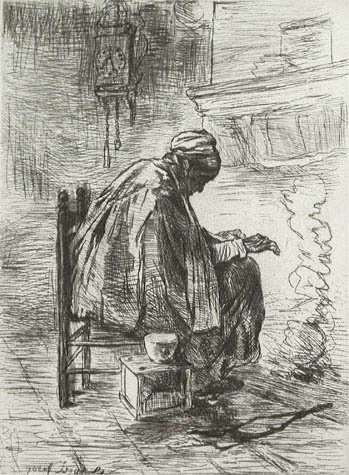
| Jozef Israels's "The Hearth" is an original etching by the artist in 1883. With a strong network of rapidly drawn lines and heavily areas he creates a telling work of art from a humble scene. This impression is printed upon fine china paper which is pressed onto a thick sheet of white, wove paper and containing full margins as published in 1883 by the British and Foreign Artists' Association and bearing their official blindstamp in the lower right corner. "The Hearth" stands as one of Jozef Israels's largest and most impressive etchings and is also a fine original example of the art created by one of the greatest late nineteenth century Dutch artists and important member of the Hague School. |
| Title: | The Hearth |
| Artist: | Israels, Jozef (Groningen, 1824 - The Hague, 1911) |
| Date: | 1883 |
| Medium: | Original Etching |
| Publisher: | British and Foreign Artists' Association, London |
| Printer: | Chardon |
| Note: | Jozef Israels 'Josef Israels': One of the premier late nineteenth century artists of Holland, Jozef Israels first studied under Kruseman in Amsterdam. Israels left Holland for Paris in 1845, living there for three years and frequenting the salons of Vernet and Delaroche. Initially influenced by Romanticism, Jozef Israels first established his reputation as a historical painter. Later, he turned his talents to landscape painting but it wasn't until the Paris Exposition of 1878 that the true genius of Jozef Israels became apparent. Here, for the first time, were those powerful studies of peasant life on which his fame now rests. |
| Probably the most important member of the Hague School, Israels shaped the course of Dutch art during the late nineteenth and early twentieth centuries. He created but thirty etchings (the earliest dating from 1870) but here, as in other aspects of his art, he is considered a master. "The Hearth" stands as one of Jozef Israels's largest and most impressive etchings. With a strong network of rapidly drawn lines and heavily shaded areas he creates a telling work of art from a humble scene. | |
| Critics have regularly compared the etchings of Jozef Israels to those of Millet, Van Gogh and (looking forward) to those of Kathe Kollwitz. Yet in the manner of Israels reveals the artistic truth of his uncluttered portrayals an even greater name is broutht forward: | |
| "Josef Israel's few plates of peasant life, strong in line, powerful in chiaroscuro, rank directly with his paintings in the expression of the depths of human feeling, in which he was so worthy a succesor of Rembrandt." (A. M Hind, A history of Engraving and Etching, Dover, New York, 1963). | |
| Raisonne: | H. J. Hubert, The Etched Work of Jozef Israels: An Illustrated Catalogue, Scheltema en Holkema's Boekhandel, Amsterdam, 1909. Catalogue # 29, First and only State. |
| Hubert writes that "The Hearth" was published in one edition only by Knoedler & Company in New York and the British and Foreign Artists' Association on July 18, 1883 in London. No further editions were made. All impressions of this important etching bear the official blindstamp of the Printseller's Association in the lower right corner, beside the title. Publishing information and the date of issue are printed in the upper margins. | |
| Size: | 16 X 11 1/4 (Sizes in inches are approximate, height preceding width of plate-mark or image.) |
| Matted with 100% Archival Materials | |
| Condition: | Printed by Chardon upon fine china paper which is pressed onto a thick sheet of white, wove paper and containing full margins as published by the British and Foreign Artists' Association, London in 1883 and bearing their official blindstamp in the lower right corner. There is a very slight matte burning marks in the upper margin, else in fine condition throughout and a prime example of the renowned art of Jozef Israels. |
| Price: | Sold - The price is no longer available. |
| Important Information: | The artist biographies, research and or information pertaining to all the original works of art posted on our pages has been written and designed by Greg & Connie Peters exclusively for our site, (www.artoftheprint.com). Please visit us regularly to view the latest artworks offered for sale. We will soon be posting an update of our most recent research and include the biographical and historical information pertaining to our next collection of original works of art created by artists throughout the centuries. We hope you found the information you were looking for and that it has been beneficial. Our Gallery, (Art of the Print / www.artoftheprint.com) guarantees the authenticity of every work of art we sell 100%. Full documentation and certification is provided. We offer a wide selection of international fine art dating from the early Renaissance to the contemporary art period. |
Original Etching by the Dutch artist, Jozef Israels 'Josef Israels
 |
| The Hearth |
View other original works of art by Jozef Israels
| Jozef Israels (Groningen, 1824 - The Hague, 1911) | ||||||
| # | Image | Title & Artist | Medium | Date | Source | - |
| 01- |  |
Oud en Versleten (The Old Couple) by Jozef Israels | Original Etching | 1873 | Printed upon fine laid paper and with full margins as published by Macmillan and Co., London for Philip Gilbert Hamerton's Etching and Etchers in 1880. H. J. Hubert, The Etched Work of Jozef Israels: An Illustrated Catalogue, Amsterdam, Scheltema en Holkema's Boekhandel, 1909. Catalogue Hubert VIII. | Sold |
| 02.- |  |
The Hearth by Jozef Israels | Original Etching | 1883 | Printed by Chardon upon fine china paper which is pressed onto a thick sheet of white, wove paper and containing full margins as published by the British and Foreign Artists' Association, London in 1883 and bearing their official blindstamp in the lower right corner. Catalogue # 29, First and only State. | Sold |
| Selected Directories in our Gallery (Art of The Print / www.artoftheprint.com), with a focus on the area of interest for this original work of art. | |
| Art of the Print / www.artoftheprint.com sells international fine art. Our collection consists of original paintings, watercolors, drawings, and original prints, such as etchings, engravings, lithographs, woodcuts, silk-screens, aquatints, mezzotints, linocuts, monoprints, and other mediums of original art. All of these works of art have been created by prominent and established painters, illustrators, watercolour artists and printmakers from around the world. The art in our gallery ranges from the early Renaissance period to the modern and contemporary art period. You can view other original artworks similar to the subject under discussion on this page listed in the following art directories. | |
| Century: | |
| Fine 19th Century Artist Index | The 'Fine 19th Century Art' directory contains a selection original works of art created by international painters, illustrators and graphic artists. These original works date from 1800 to 1899. |
| Country: | |
| Dutch & Flemish Artist Index | This directory contains a listing of original works of art created by Dutch & Flemish artists and or views of Holland or art with a Dutch theme. The artworks date from the 17th century to the 20th century. |
| Subject: | |
| Portraits & Figure Studies Index | The 'Portrait Studies' directory contains a listing of original works of art concentrating upon the theme of portraits, self-portraits and studies. Created by International artists throughout the centuries, these fine examples of portraiture have left a permanent and vivid record of their sitters. |
| Women Portrayed in Art Index | The 'Women in Art' directory contains a selection of original works of art with depictions of women in an almost infinite variety of roles, such as women as an object of beauty & desire, at work and of course, motherhood are major themes, as well as many other representations of women have emerged in the fine arts throughout the centuries. |

Customer inquiries: Contact us  or
phone Greg & Connie (905) 957-6666
or
phone Greg & Connie (905) 957-6666
www.artoftheprint.com - Home | About Us | Artist Index | Gallery | Catalogue | Our Policy | Contact Us | Site Map
| © copyrighted by Art of The Print / www.artoftheprint.com / Greg & Connie Peters. All Rights Reserved. |